
Two Family IDs in the System: How to Merge or Correct Them?
If your family finds out there are two separate Family IDs in the system for the same household, don’t panic. It happens. But it’s important to fix it because duplicate IDs can cause problems with schemes, benefits, and eligibility.

Why Duplicate Family IDs Are a Problem
The government uses your Two Family IDs in the System database to check eligibility for things like pensions, scholarships, and subsidies. If there are two IDs, one may show as inactive or duplicates may block benefits.
Duplicate records can cause confusion about who in your family is covered, or even lead to cancelled benefits if a mismatch is detected.
It slows down processing and may create verification problems when you apply for a scheme.
How to Correct or Merge Two Family IDs
Here’s what you can do, step by step:
Find out the Two Family IDs in the System
in question and note the details of each (family head, address, Aadhaar numbers etc.).
In states like the example of Parivar Pehchan Patra (Haryana), there’s a specific option to merge two families/IDs.
You’ll likely need to give Aadhaar of all members, proof that both IDs refer to the same household, and maybe a signed declaration. Merging IDs may affect Family ID validity and renewal.
If you can’t do it online, you can visit a Common Service Centre (CSC) or relevant local office and ask for “merge family ID” help.
Once the IDs are merged, you should get a merged Family ID or one ID deactivated and the other retained. Check that all your family members now show under the correct ID.
After merging, verify that all benefits, schemes and the family details (income, address) are correct under the merged ID.
Documents Required for Merging Family IDs
Before starting the merge or correction process, keep all necessary documents ready. This will make the process faster and smoother.
Commonly required documents may include:
Make sure the names, address, and other details are consistent across the documents.
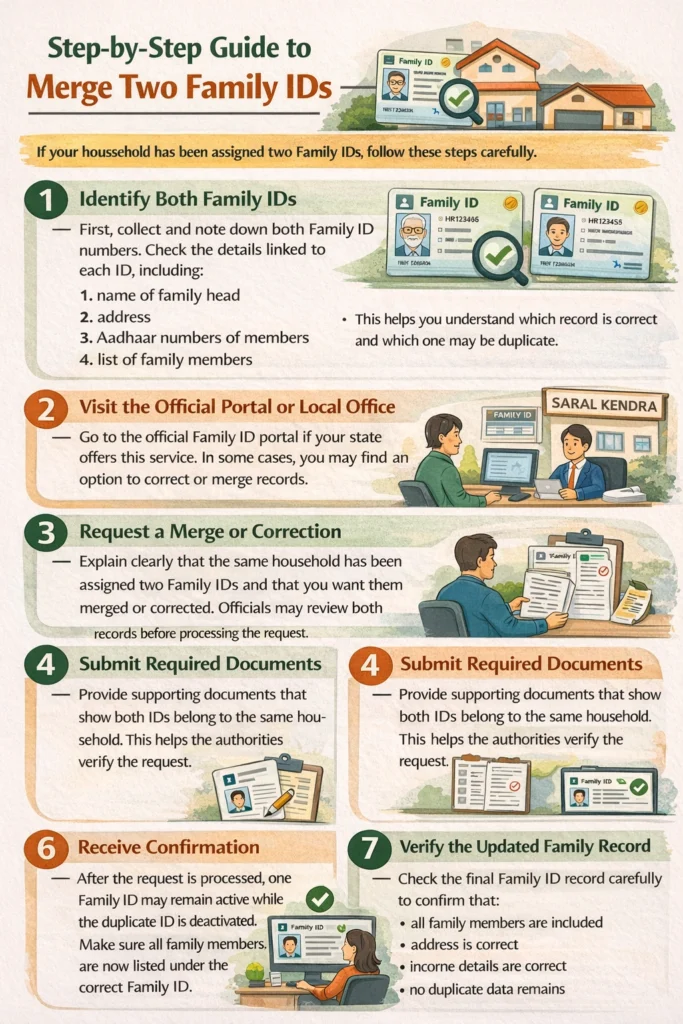
Step-by-Step Guide to Merge Two Family IDs
If your household has been assigned two Family IDs, follow these steps carefully.
Identify Both Family IDs
First, collect and note down both Family ID numbers. Check the details linked to each ID, including:
1.name of family head
2.address
3.Aadhaar numbers of members
4.list of family members
5.income details if shown
This helps you understand which record is correct and which one may be duplicate.
Visit the Official Portal or Local Office
Go to the official Family ID portal if your state offers this service. In some cases, you may find an option to correct or merge records. If the online option is not available, visit a CSC, Saral Kendra, or local welfare office.
Request a Merge or Correction
Explain clearly that the same household has been assigned two Family IDs and that you want them merged or corrected. Officials may review both records before processing the request.
Submit Required Documents
Provide supporting documents that show both IDs belong to the same household. This helps the authorities verify the request.
Complete Assisted Update if Needed
If self-service merge is not available online, the CSC operator or local official may process it through the assisted update system.
Receive Confirmation
After the request is processed, one Family ID may remain active while the duplicate ID is deactivated. Make sure all family members are now listed under the correct Family ID.
Verify the Updated Family Record
Check the final Family ID record carefully to confirm that:
1.all family members are included
2.address is correct
3.income details are correct
4.no duplicate data remains
How to Check Linked Benefits After Merge
Once the two Family IDs have been merged, it is important to check that your family’s benefits are correctly linked to the active record.
Check the Active Family ID
Log in or visit the concerned office to confirm which Family ID is now active.
Review Family Details
Make sure the final record shows the correct family members, address, income, and category details.
Verify Scheme Status
Check whether pensions, scholarships, ration benefits, subsidies, or any other linked schemes are now attached to the active Family ID.
Follow Up if Any Benefit Is Missing
If a benefit does not appear after the merge, contact the relevant department or CSC and show the updated Family ID details.
Keep Proof of the Merge
Save a screenshot, printout, acknowledgement receipt, or reference number. This can help later if any scheme record needs correction.
Why Duplicate Family IDs Cause Problems
Duplicate Family IDs may seem like a small mistake, but they can create serious problems in government records.
The government uses Family ID data to check whether your household qualifies for pensions, scholarships, ration benefits, and subsidies. If there are two IDs, the system may treat one record as inactive or flag both as duplicate, which can affect eligibility.
Duplicate IDs can create confusion about which family members belong to which household record. This may lead to incomplete or incorrect records.
When duplicate records exist, government verification may take longer. This can delay approvals or create issues during document checks.
In some cases, benefits may stop, get delayed, or go to the wrong record if the system finds a mismatch between the two Family IDs.
Why You Should Regularly Check Your Family ID Records
It’s a good habit to periodically check your Family ID, even if you’re not aware of any changes. This helps ensure that:
There are no duplicate records or mismatched data.
You’re still eligible for all the benefits linked to your Family ID.
You can quickly spot any mistakes before they cause issues with government services.
When you notice any discrepancies or updates needed, take care of them right away to prevent future problems. Regularly verifying your Family ID will save you from unnecessary delays and confusion. This may be necessary after you update your Family ID address.
Preventing Duplicate Family IDs in the Future
To prevent future problems with duplicate Family IDs, here are a few steps you can take:
Ensure accuracy during registration: Double-check your details when applying for the Family ID for the first time. Confirm the names, addresses, and Aadhaar numbers are correct.
Notify authorities promptly about changes: Whenever a family member is added or removed, or there are significant changes, update your Family ID immediately.
Avoid multiple applications: Ensure that you or any family member is not mistakenly applying for multiple Family IDs. Sometimes, this can happen if different members apply independently.

Tips to Make It Easy
FAQs
Conclusion
Discovering that your family has two separate Family IDs might feel stressful, but the good news is: you can fix it. Take swift action to merge the records so your family’s data is clean, benefits continue smoothly, and there are no surprises later. Treat it like cleaning up your household’s master file—it takes a bit of work once, and then you’re set up smoothly for the long term.


