
Complete Guide to Link Family ID with Digital Payment Scheme
Updating or linking your PPP Family ID to digital payment schemes can make getting government benefits much easier. Instead of filling out forms again and again, a linked Family ID connects everything in one place and helps the government send your benefits directly — fast, smooth, and without hassle.
What Is a Family ID?
A Family ID (also called Parivar Pehchan Patra in places like Haryana and UP) is a unique code given to each family that stores basic information like:
This system helps the government manage accurate data on families and decide who is eligible for which benefit or scheme. With the Family ID, you don’t need to repeatedly share the same information for every new scheme.
Why You Should Link Family ID to Digital Payment Schemes
Linking your Family ID to digital payment schemes brings several real benefits:
When your ID is linked, the government can send payments like pensions, subsidies, or financial assistance directly to your bank account digitally.
Once linked, you don’t need to submit the same documents every time you apply for a scheme.
Officials use the information stored in the Family ID to check eligibility, so you won’t lose out on benefits you deserve.
Digital linking reduces errors, delays, and confusion in receiving benefits, and ensures your information is used properly.
Across India, integrating family data with digital platforms is part of a bigger push to make government benefits more transparent and faster. That includes linking Family ID with digital India systems like e‑Passbooks, Aadhaar, and digital payment platforms.
How Linking Works — Simple Steps
Here’s a friend‑like explanation of how linking your Family ID to digital payment schemes typically works:
Check Your Family ID Status
First, make sure you already have a valid Family ID. You may need to log into the official portal and confirm your details.
Add Bank and Aadhaar Information
The next step is to associate your Aadhaar and bank account details with your Family ID. This is essential for receiving digital payments directly into your account.
Complete KYC and Consent
Most systems require you to verify your identity through a simple mobile OTP or panel. You may be asked to give consent for linking your bank account and Aadhaar to the system.
Update Government Portals
Once everything is linked, the system shares your eligible benefit information with digital payment schemes or services so funds can be transferred directly where they belong.
Many states are also integrating Family ID with digital passbooks and welfare portals, so you can check what benefits you are receiving — and what you are eligible for — in one place. In 2026, same-sex couples in Haryana can update their Family ID by following a simple process to ensure all details are correct.
Tips to Make the Process Smooth
Here are a few quick tips to avoid delays:
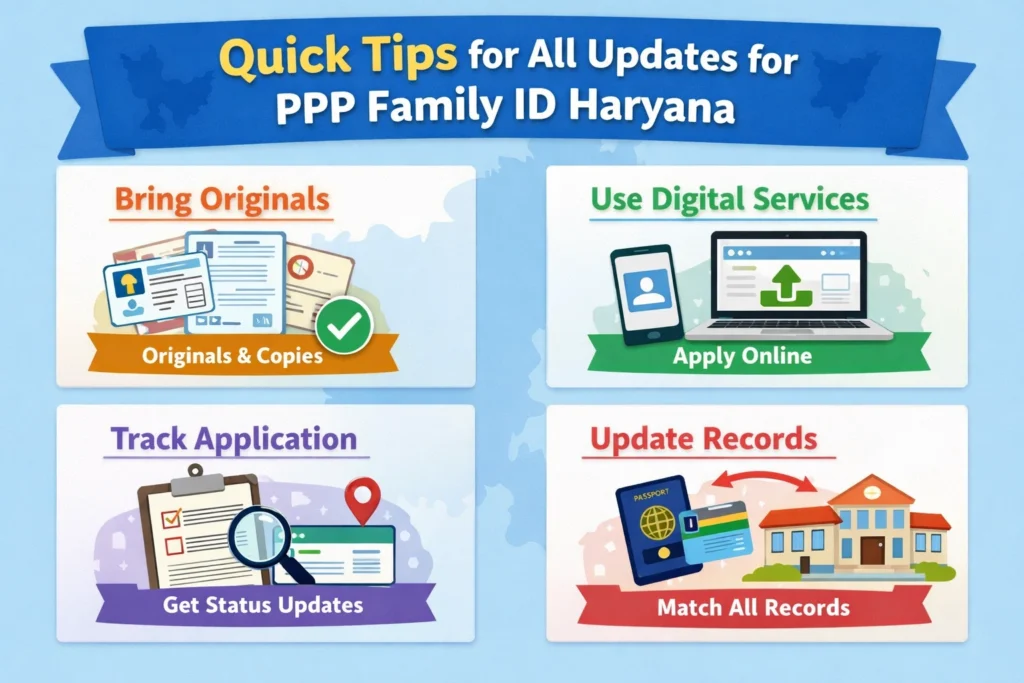
Keep Your Aadhaar Updated
Make sure your name, mobile number, and address on Aadhaar match what you have in your Family ID database.
Use a Linked Bank Account
Open a bank account that is already linked to your Aadhaar. This makes it easier for digital payments to reach you.
Track Your Status Online
Once linked, regularly check your payment and benefit status online. Many portals show what benefits are active.
Don’t Delay Updates
Any change in address, mobile number, or family members should be updated promptly so linking stays accurate.
Real Advantage: Direct Benefit Transfer (DBT)
Linking your Family ID to digital payment schemes is closely tied to India’s Direct Benefit Transfer (DBT) mechanism. DBT sends benefit money directly to beneficiaries’ bank accounts using Aadhaar or other verified digital IDs.
Without a linked Family ID and Aadhaar, DBT may not work smoothly. When both IDs are connected, your subsidy, pension, or cash benefit goes straight to your bank account without middlemen or delays.
Common Scenarios You Might Encounter
FAQs (People Also Ask)
Final Thoughts
Linking your Family ID to digital payment schemes is one of the best things you can do to ensure quick, accurate government benefit delivery. It saves you time, reduces stress, and keeps your benefit records in one place. Once your Family ID is connected with digital systems, you can focus less on paperwork and more on receiving your entitlements smoothly. That’s what digital governance is really meant for.


